Solar Time
12:00 PM
Current Solar Term:
Major Snow
Guidance Note
Major Snow is a time to protect warmth and fluids. Choose gently cooked foods and keep routines steady, with earlier nights when possible.


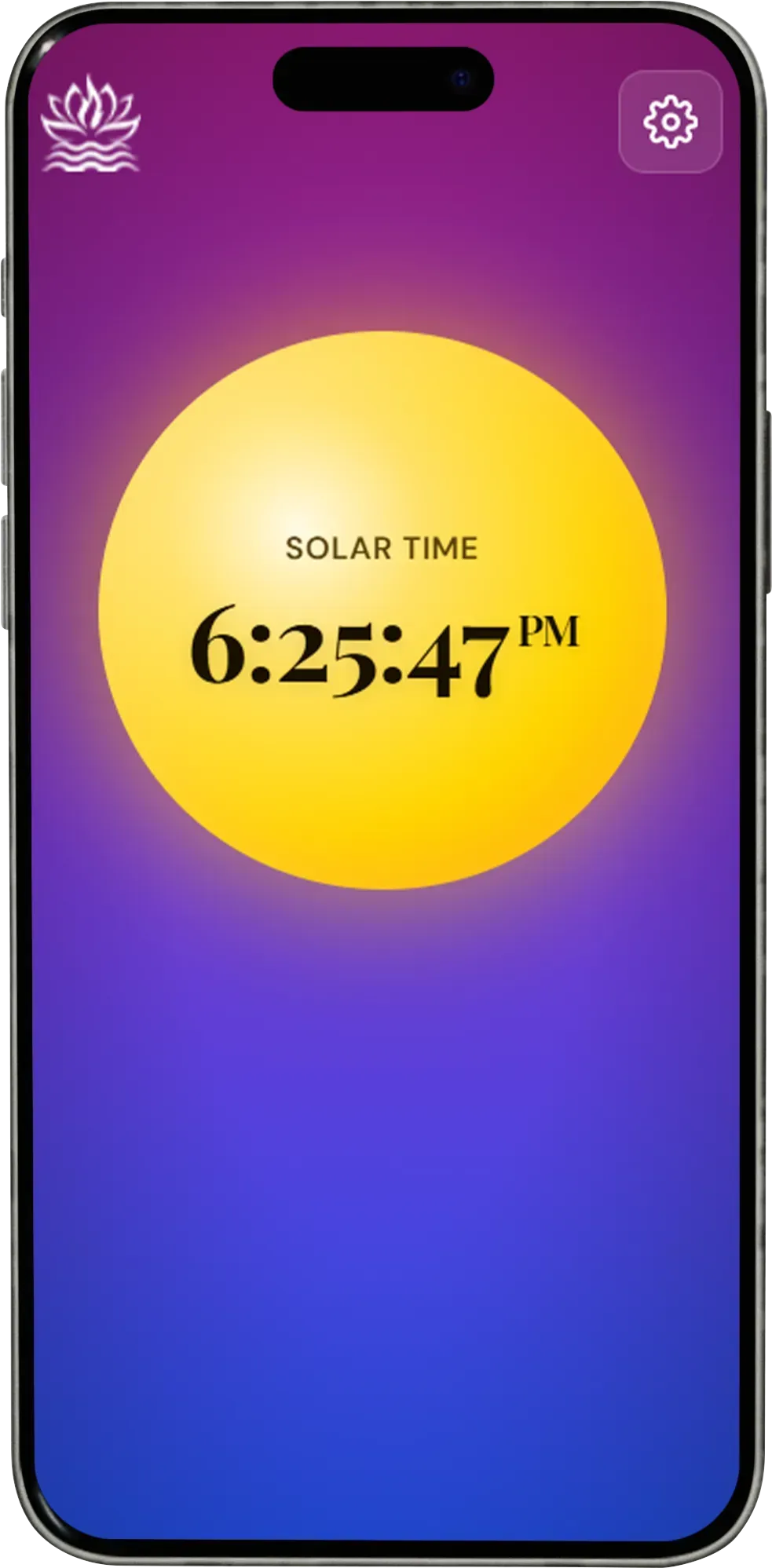
Shows the current solar time inside the glowing sun in the center of the screen.
Shows solar time with seconds added, updating continuously.
Shows solar time plus a “Current Solar Term” label and a short seasonal guidance note underneath.
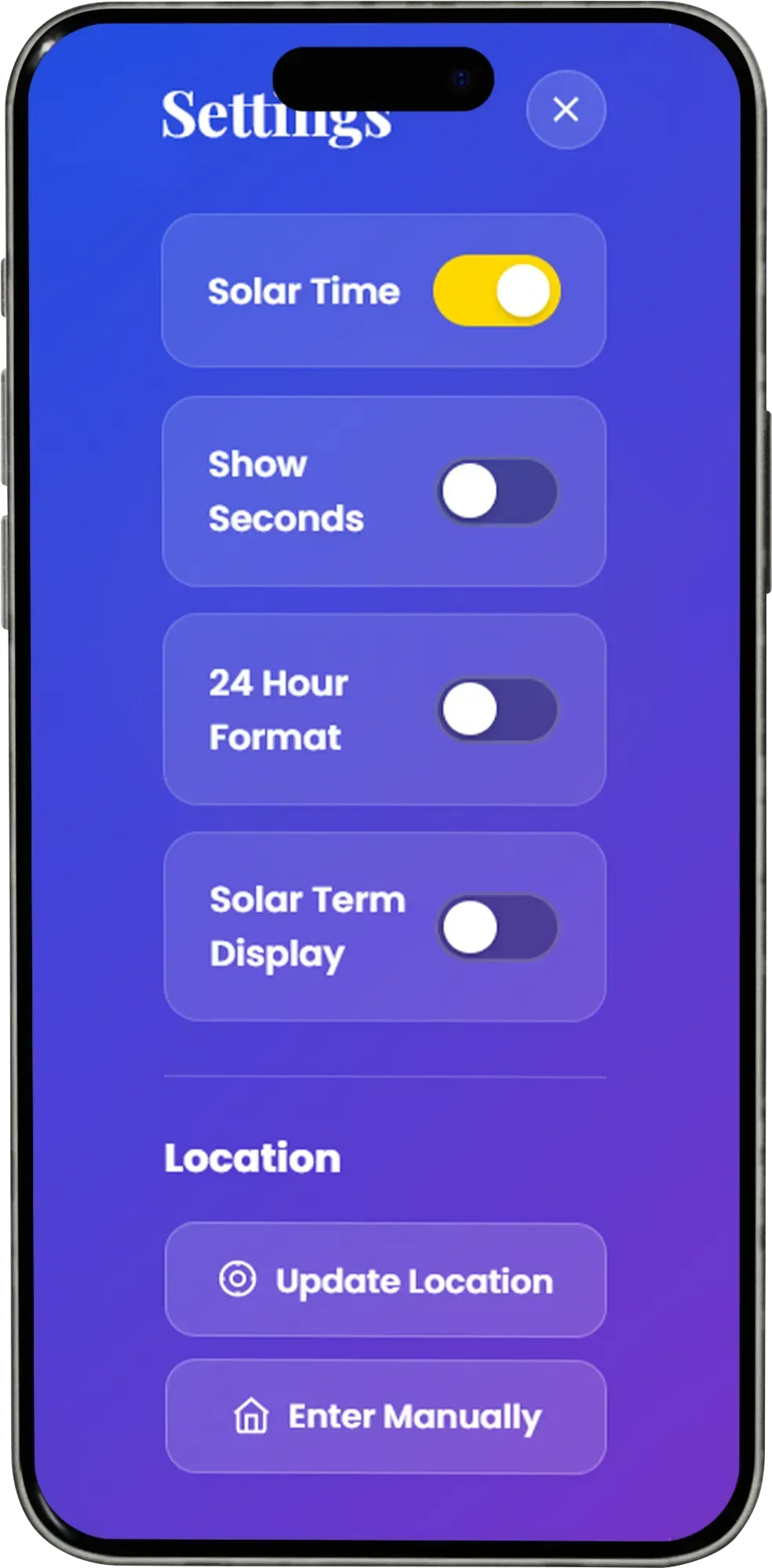
Shows the settings panel where you turn features on or off, including solar time, seconds, 24-hour format, and solar terms.
After you add it, you’ll see a “True Solar Time Clock” icon on your home screen. Tap it anytime to open the clock fast.
A solar time clock (often called a solar clock or true solar time clock) shows time based on the sun’s position rather than time zones alone. Clock time is standardized for convenience, but true solar time shifts slightly depending on your longitude and the date. That is why solar time in one city can differ from solar time in another, even if both share the same time zone.
This tool calculates true solar time by using your longitude and a standard solar correction called the Equation of Time. The goal is a clear, fast “at-a-glance” solar time display you can use for daily timing, study, and traditional time-based systems. If you allow device location, the clock can calculate solar time more precisely. If you prefer, you can enter longitude manually and still use the solar clock with accuracy.
Most of us live by time zones, calendars, and busy schedules, but the body still responds to light and daily rhythms. A solar time clock gives you a simple way to see how your local day is actually unfolding where you live, which can be surprisingly useful for everyday routines.
For daily living
For TCM students and practitioners (educational use)
This True Solar Time Clock calculates solar time using your longitude plus the Equation of Time, then displays the result clearly on your screen. For best accuracy, allow device location so longitude is captured correctly. If you prefer not to share location, you can enter longitude manually in Settings and the clock will still calculate true solar time.
Your location is used only to calculate solar time and does not need to identify you. The Solar Clock is designed to be lightweight and safe:
A solar clock is not just a curiosity. It is a practical way to align daily choices with the same natural timing that underlies many Traditional Chinese Medicine rhythms. When you use solar time, “noon” is closer to when the sun is highest where you live, and the rest of the day follows that local arc. This matters because TCM timing is built on relationships between the body, the environment, and daily cycles, not on a one-size-fits-all clock.
Below are practical ways to use a solar clock without making life complicated.
Start with one habit. Pick a daily anchor you already do, like breakfast, your first cup of tea, a short walk, or your evening wind-down. Check your solar clock for a week and notice what changes when you align that one habit with solar timing. The purpose is not perfection. It is a steadier relationship with time that supports your health and your practice.
People often hear about the Chinese Organ Clock and assume it works like a strict schedule. In real life, it is more useful as a way to notice patterns in the day. A solar clock adds a modern layer of clarity because it tracks solar time based on the sun’s position where you actually live. When you put those two ideas side by side, you get a simple, practical question: are your daily patterns lining up with the natural day, or are they being pulled around by the demands of modern schedules?
This matters because standard clock time is built for coordination across a whole time zone, while solar timing is local. Two people can share the same time zone and still experience meaningful differences in sunrise, solar noon, and sunset. A solar clock helps you see those differences and makes “time of day” feel less abstract. It becomes anchored to daylight, which is one reason solar time can be a helpful reference for people exploring TCM timing concepts.
In Traditional Chinese Medicine, the Organ Clock is commonly used as a framework for observing how energy, rest, appetite, and mental clarity can shift across the day. It is not a rigid rule that tells you what must happen. It is a lens for noticing trends.
For example, if someone consistently feels a drop in energy or a change in digestion at a similar time each day, the Organ Clock gives practitioners and students a traditional language for discussing that pattern. The main value is in the noticing. Patterns that repeat are often the ones worth paying attention to.
Here is where a solar clock becomes useful. Many people describe their daily patterns using standard time: “I crash at 2:00,” “I wake at 6:30,” “I get hungry at noon.” But if you live far east or west within your time zone, those clock labels may not match the sun’s position very well. Over time, that mismatch can make timing discussions feel inconsistent.
Using solar time gives you a stable reference that is tied to nature rather than a time zone grid. Instead of asking, “What time is it?” you can ask, “Where am I in the solar day?” That shift can make self-observation more accurate. It also helps practitioners speak to patients in a way that feels more individualized.
If you want to use these ideas without turning your life into a spreadsheet, keep it simple and choose one or two signals to track.
Step one: choose a signal. Pick one of the following:
Step two: track it with solar time. For seven days, jot down when that signal is strongest and when it changes. Use your solar clock as your time reference. You are not trying to prove a theory. You are simply collecting a small, honest set of observations.
Step three: compare patterns. After a week, look for repeats. If a pattern shows up again and again, it becomes useful. This is where the Organ Clock can serve as a language layer. It gives you a traditional framework for discussing what you are seeing, without forcing you into rigid timing rules.
For practitioners, the goal is not to overwhelm patients with timing concepts. The goal is to give them a tool they can actually use. A solar clock can support this in a few practical ways.
The Organ Clock provides a traditional lens. A solar clock provides a precise, location-based reference for solar time and solar timing. Together, they support something simple: better self-observation and more grounded timing decisions. You do not need perfect adherence. You need a clear reference point and a willingness to notice what repeats.
If you use the solar clock as your anchor and the Organ Clock as a framework for reflection, timing becomes less about rigid rules and more about living in a way that fits the day you are actually in.
We are building this Solar Clock as two guided experiences, so it stays simple for beginners and still supports clinical timing needs for practitioners. Both versions use the same accuracy core for solar time and solar timing, including longitude correction and the equation of time, so the solar clock remains precise for your location.
The student version is designed for learning and daily use. It keeps the interface clean, with optional on-screen helpers you can turn on as you study. This includes an easy view of true solar time, a Solar Term badge with a short seasonal guidance note, and simple explanations that help you connect timing to everyday TCM living.
The practitioner version adds optional professional tools that can be turned on or off in Settings. These include a Qi Clock window indicator, a chrono-acupuncture helper view for “open point” timing windows, and a Confidence Panel that can display the longitude used, DST status, and the solar offset compared to standard clock time. The goal is fast, clear timing support that does not slow down your workflow.
Both versions are being built to be installable from cultivatingharmonytoday.com, with no tracking, no analytics, and no required paid APIs.
Any information on this website/blog does not replace the advice of a doctor. If you think you may have a medical emergency, call your doctor or 911 immediately. Cultivating Harmony Today or its publisher disclaims any warranty or liability for your use of any information obtained from this site. Your use of this information means that you agree to the
Terms and Conditions Agreement.
read more...
Cultivating Harmony